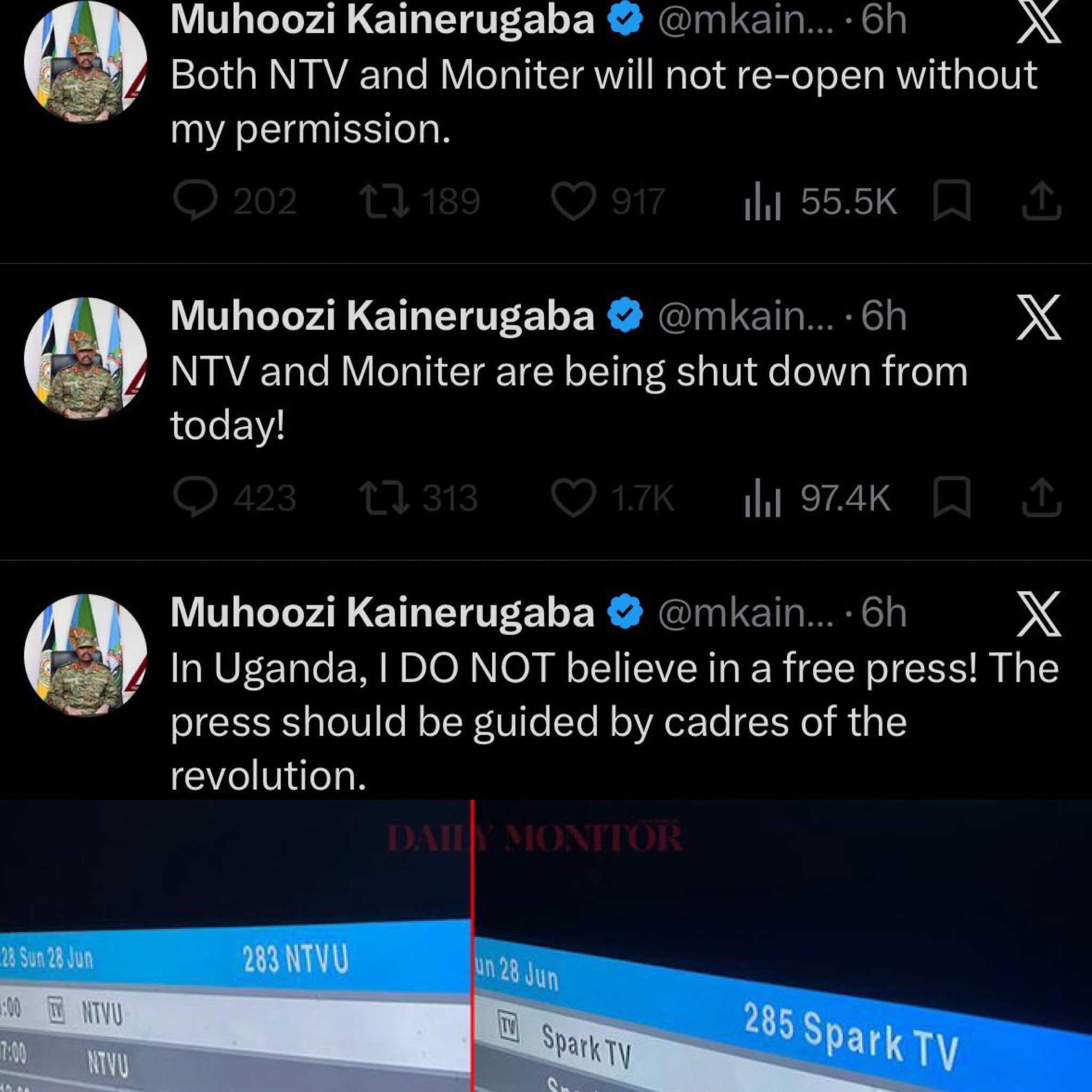
Uganda’s Chief of Defence Forces (CDF), General Muhoozi Kainerugaba, has ordered the shutdown of NTV Uganda, Spark TV, Dembe FM , K FM and the Daily Monitor,declaring that he does not “believe in a free press.”
The Nation Media Group (NMG), a leading media conglomerate headquartered in Kenya, owns several outlets in Uganda, including the Daily Monitor newspaper, Spark TV, NTV Uganda, and radio stations such as KFM and Dembe FM.
They were taken off air in the early hours of Sunday June 28,2026 following a heavy overnight security operation at NMG’s offices in Kampala.
The crackdown came after General Kainerugaba, who is also President Yoweri Museveni’s son, posted a series of incendiary messages on X. In one, he announced: “Mzee has approved my plan to close both NTV and Monitor. We are moving immediately!”
“From now on ALL bad stories about Uganda have to be cleared by my office! In Uganda, I DO NOT believe in a free press! The press should be guided by cadres of the revolution,” he added.
“I have the power in Uganda to shut down ANY media house I want to. I have had this power since 2017. This power was given to me by my great father President.”
Uganda Editors’ Guild condemns the “unlawful” closure , calls for unconditional reopening https://x.com/i/status/2071266542851961006
Uganda Communications Commission says engagements continue and further updates will be communicated https://x.com/i/status/2071264232591577568
National ASSOCIATION OF BBROADCASTERS MONITORING THE SITUATION https://x.com/i/status/2071265483999842630
Also Read- REPORT: Police Top Human Rights Violation Complaints in 2025
Also Read – New ACME Report: The Widening Gap between Uganda’s Media Laws and Constitutional Protections
2013 MUHOOZI PROJECT SAGA. Similarly, in May 2013, Uganda witnessed one of its most dramatic confrontations between the state and the press. Armed police officers stormed the offices of the Daily Monitor newspaper in Kampala, shutting down its operations along with its sister radio stations, KFM and Dembe FM.
The raid followed the publication of a controversial letter attributed to General David Sejusa, then Coordinator of Intelligence Services.
The letter alleged that President Museveni was secretly grooming his son, Kainerugaba, to succeed him as head of state. It went further, warning of a plot to eliminate senior officials opposed to this succession plan.
The explosive claims quickly became known as the “Muhoozi Project,” a phrase that entered Uganda’s political vocabulary and ignited fierce debate about succession politics and the future of the country’s leadership.
Human rights organizations argued that the government’s heavy-handed response revealed deep anxiety about public discussion of succession and the role of the military in politics.
Although the Daily Monitor eventually reopened, the incident left a lasting mark.
The “Muhoozi Project” controversy underscored the fragility of media independence in Uganda and highlighted the risks faced by journalists reporting on sensitive political issues.
It remains one of the most vivid examples of how questions about succession and power in Uganda have repeatedly collided with the struggle for a free press.